



Less WIP, shorter lead times: two concrete methods

By Pascal Pollet – Sirris, Belgium
In an earlier article, we discussed the benefits of reducing Work In Progress (WIP). Reducing WIP in manufacturing ensures shorter and more stable lead times. This makes production more predictable and planning work easier. But how much WIP is too much? And how do you reduce it as much as possible?
Why less WIP is essential in manufacturing
WIP has a direct impact on both the lead time and output of a production process. Lead time is directly proportional to WIP: the more WIP, the longer it takes to complete an order. The relationship between WIP and output is more complex.
The relation between Work in Progress and output
Let’s illustrate this with an example. Suppose you have a production environment with 10 workstations and no WIP. In that case, output is zero because there are no orders available to process. With one order in circulation, only one workstation can work, representing 10% of the maximum output. Two orders would increase the output to 20% if two workstations process them separately. If they end up at the same station, it’s even less. As more orders are added, output rises to a maximum.
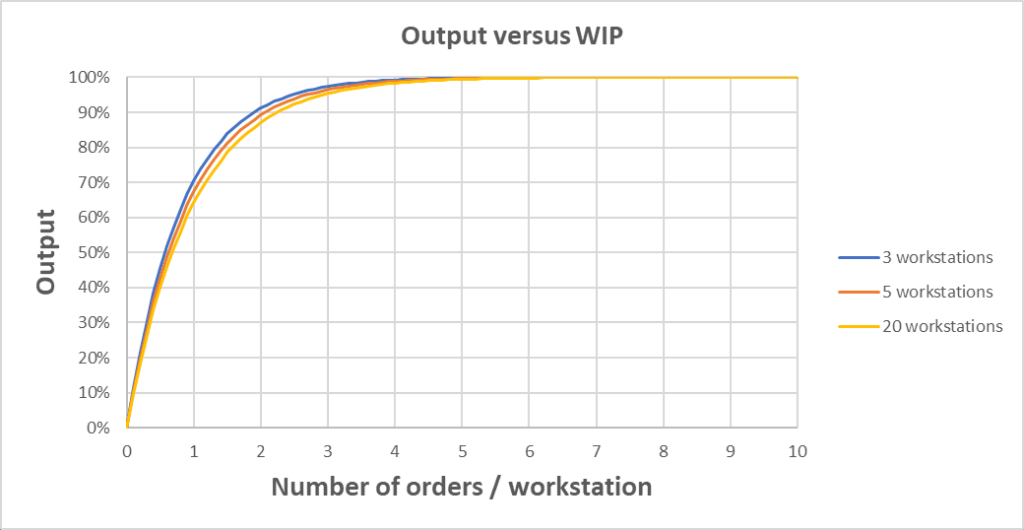
Relationship between output and number of orders per workstation for an environment with 3, 5 and 20 workstations.
Simulations show that maximum output is usually achieved at about 5 orders per workstation. This number serves as a guideline for optimal WIP. Bottleneck workstations best have slightly more WIP (6-7 orders), while less critical workstations sometimes already reach their maximum at 3-4 orders. Too much WIP does not lead to higher output, but rather to longer lead times and more complexity in planning.
Are you biting off more than you can chew?
With these guideline values, you can easily assess your own situation. Suppose:
- Your production environment has 10 workstations.
- The average lead time is 4 weeks.
- There are 200 orders in circulation.
With a guide value of 5 orders per workstation, you will ideally reduce the WIP to 50 orders. This represents a 75% reduction, with the lead time falling proportionally from 4 weeks to 1 week. This gives the planner the flexibility to release orders up to one week before the desired end date. Suppliers are also given an extra three weeks to deliver parts.
Waiting to release orders, in two cases
This brings us to the simplest method for limiting WIP: delaying the release of orders instead of starting them immediately. This can be achieved in several ways:
Case 1: Planning and release with an MRP-system
A Material Requirements Planning (MRP) system determines the start date for each production step using a process called lead time offsetting. In this approach, the system creates a reverse schedule — calculating backward from the delivery date to identify when production should begin. The calculation relies on the lead times defined for each step, which are typically set when the MRP system is first configured. These lead times are often given generous, so-called “safe” margins, such as one week (or five working days) per production step.
For a four-step routing, this means the MRP system will plan production to start four weeks (or twenty working days) before the delivery date. Within the MRP system, WIP can be reduced by gradually shortening these lead times.
This adjustment should be made incrementally — for example, by first reducing the lead time from five to four working days. The results can then be monitored for a few weeks. If no issues arise, lead times can be further reduced in one-day steps until a point is reached where additional reductions cause risks, such as idle time on critical machines.
Case 2: Planning and release without an MRP-system
If orders are released manually, the planner can temporarily reduce the daily release volume — for example, by 10–20%. By releasing fewer orders, the inflow to production decreases, which in turn reduces the overall WIP.
Once it becomes clear that further WIP reduction is no longer desirable, the planner can return to the original release rate to prevent the shop floor from becoming idle. To maintain a stable WIP level thereafter, the planner can align the daily number of released orders with the number of orders completed. This approach keeps the amount of work in progress on the shop floor balanced and under control.
Ready to improve efficiency in your manufacturing business?
Find out more about our expertise in Quick Response Manufacturing and how we can help you optimise production with less Work in Progress.